
Whether government agencies AI use, is decided. Open iswhere they runs – and where her Results arrive. Three Operating Models stand today On the Election: public Cloudservices, sovereign clouds, and government-owned Platforms. They distinguish itself before above all in it, which Information she process may.
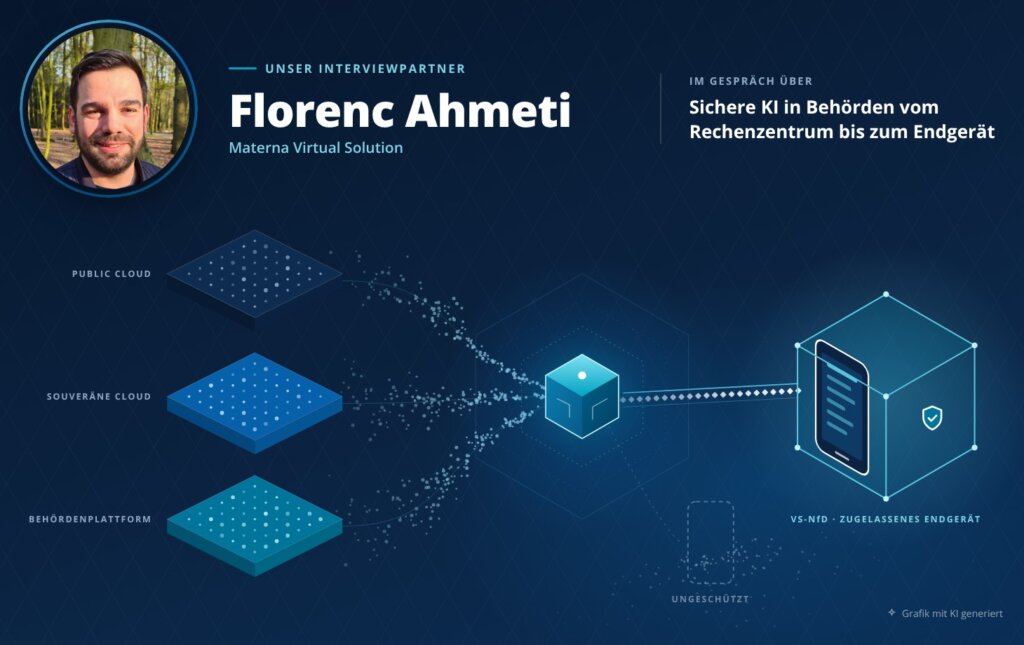
Florenc Ahmeti, AI Enablement & Product Innovation Manager, explains why the cloud, sovereign platforms, and proprietary AI infrastructures are only secure if their results can also be used securely on mobile devices.
Question 1: Everyone is talking about AI in government. How urgent is the need for action, really?
Larger than many discussions suggest. According to McKinsey, the public sector is currently short about 550,000 full-time employees; by 2030, that number will rise to about 840,000 because more than 1.5 million employees will retire (McKinsey 2023). Generative AI could reduce this gap by up to 165,000 positions—or about one-third (McKinsey 2024).
However, the studies also point out what is missing. BCG estimates the global productivity potential in the public sector at 1.75 trillion U.S. dollars per year through 2033—while noting that accuracy, oversight, data protection, and confidentiality remain unresolved issues (BCG). The BSI advises government agencies to conduct their own risk analysis for each use case (BSI). The bottleneck, therefore, is rarely the use case itself. It lies in determining where specific data may be processed.
Question 2: Powerful AI assistants have long been available as cloud services. Why isn’t that enough for government agencies?
For open information, it’s often sufficient. Researching public sources, drafting communications for citizens, translating texts that aren’t sensitive—public cloud services are readily available for these tasks, provide the latest models, and are billed only on a pay-as-you-go basis.
The line is clear: processing takes place outside the agency’s control, raising questions about data outflow, training, and access by third countries. There is no authorization for classified information at the VS-NfD level or higher. However, I see the greater risk in unofficial use: If there is no secure option available, employees copy content into private AI apps. This “shadow AI” is beyond any control.
Question 3: Sovereign clouds promise the best of both worlds. Do they live up to that promise?
To some extent. The best-known example is the Delos Cloud: It is based on Microsoft Azure technology, is operated by an SAP subsidiary, and is designed to be able to process classified information (Microsoft/Delos). SAP also plans to offer OpenAI models there (Tagesspiegel Background). This is attractive for government agencies with strong ties to Microsoft: familiar applications, up-to-date models, and no need for their own data centers.
However, there are three points that should be viewed objectively. The federal government will assess whether information security and confidentiality requirements are being met through the end of 2026. According to Delos, prices are 10 to 20% higher than those of the public cloud (heise). Furthermore, technological dependence on the U.S. provider remains—a point also criticized by experts in the field. Anyone choosing this model must carefully verify the certification status for their own security class.
Question 4: The federal government and the states are developing their own AI platforms. Is that the safer approach?
It’s the approach that offers the most control, but requires some effort on your part. At the federal level, there’s KIPITZ, the AI portal of ITZBund. It uses vendor-neutral language models and has been rolling out on a large scale since late 2024. Government agencies don’t pay a license fee, but they provide the hardware and cover operating costs (CIO). In Baden-Württemberg, F13 is expected to have over 100,000 users by the end of 2026 (oeffentlicher-dienst-news.de).
The advantage is obvious: operation in government data centers, freedom to choose models, and integration with specialized systems. However, the models are often smaller, and organizations must provide their own computing capacity and specialized staff. What’s exciting is that the lines are currently blurring: In May 2026, the Federal Ministry of Digital Affairs commissioned Telekom and SAP to develop a sovereign AI platform on which KIPITZ is set to be one of the first applications to run on it.
Question 5: You mention a blind spot in many AI strategies. Which one are you referring to?
The end device. All three models secure the location where the AI performs its computations. Hardly any strategy secures the location where the results are viewed. If an AI summarizes a VS-NfD document, the summary is generally also classified as VS-NfD. It may only be displayed, stored, and further processed on devices that are authorized for that purpose.
This is handled in the office, but often not when on the go. Government agency leaders, crisis management teams, and field staff, in particular, need the information they need to make decisions on their smartphones and tablets. If there’s no approved environment available, two poor options remain: either the AI results stay on the desk and the time saved goes to waste, or they’re shared via private channels, compromising the security policy.
That is why mobile devices are an essential part of any AI architecture. This requires container solutions that technically isolate official data from the rest of the device and are approved by the BSI for VS-NfD. This is our area of expertise: SecurePIM can be used for VS-NfD and NATO RESTRICTED. Whether the results come from a government platform or a sovereign cloud is secondary. What matters is that the chain remains closed all the way to the screen.
Question 6: What advice would you give to agency leaders and safety officers before they make a decision?
Five questions to answer together before choosing an operating model:
- Which protection classes does this use case involve?
An assistant for citizen inquiries and one for situation reports require different models - Where is the processing done, where is the data stored, and where is it displayed?
The answer must be provided for all three locations, not just the data center. - Who works with the results on the go?
Without approved devices, the benefits end at the desk. - How can “shadow AI” be prevented?
Bans alone don’t work if the official service is slower than the private app. - How can the agency remain adaptable?
Model-independent platforms and open interfaces limit future dependencies.
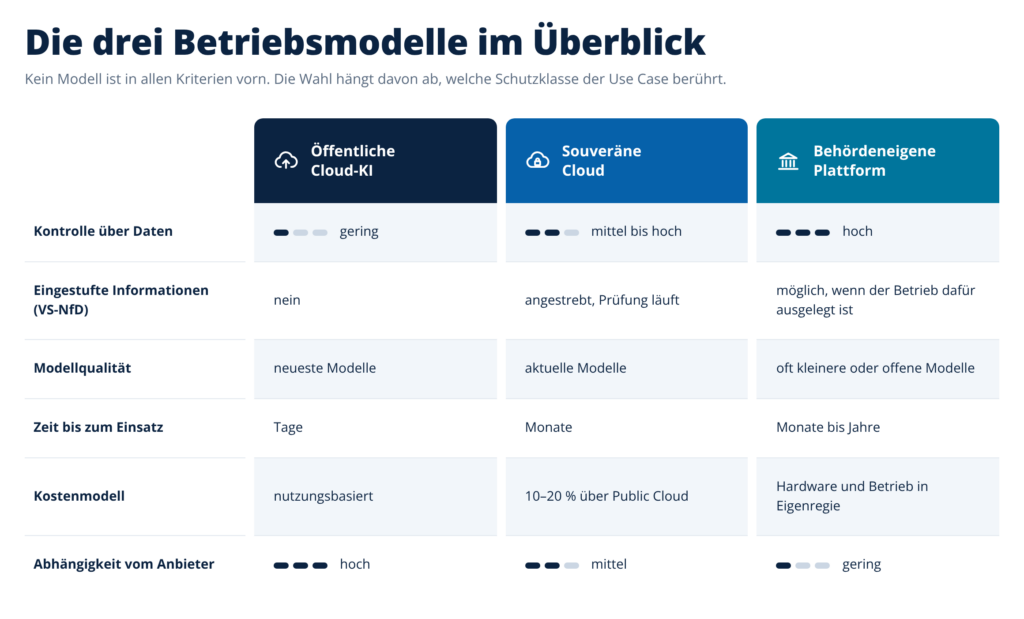
An AIstrategy for Government Agencies is none Decision in favor of a only model, but one Assignment: open Data to the cloud, classified Data on sovereign or own Platforms and the results only on devicesthat are approved are. Who only the data center covers, gives away the efficiency gains or risks the outflow.
Safe AI doesn’t end in the data center. It doesn’t end until it reaches the user’s screen.
Contact us
Do you have questions about our solutions? Do you want an individual live demo? Or an offer right away? We will get back to you immediately by phone or e-mail.