Find out what Enterprise Mobility Management (EMM) is, whether it suits your company and your needs, and what alternatives are available.
Secure mobile working with Enterprise Mobility Management
Mobile working with smartphones, tablets and the like is now part of everyday life for many employees. Sending emails on the go, editing documents or setting up the next meeting: all this can be done from a mobile device. However, this also increases the IT risks for companies to. For example, by working with unauthorized apps or via unsecured networks. Enterprise Mobility Management can provide the necessary protection, but it is not the only option for mobile security. Find out here what Enterprise Mobility Management actually is and how you can use it effectively.
What does Enterprise Mobility Management (EMM) mean?
Enterprise Mobility Management, or EMM for short, comprises various technologies and processes that enable Secure use of mobile devices in the company. In general, it can be said that an EMM regulates the connection between mobile devices and the infrastructure in the company. In addition to the management of mobile devices, an EMM therefore also includes the management of applications on mobile devices and their access to company data.
If Enterprise Mobility Management is viewed in conjunction with other approaches to mobile working, the following chart emerges:
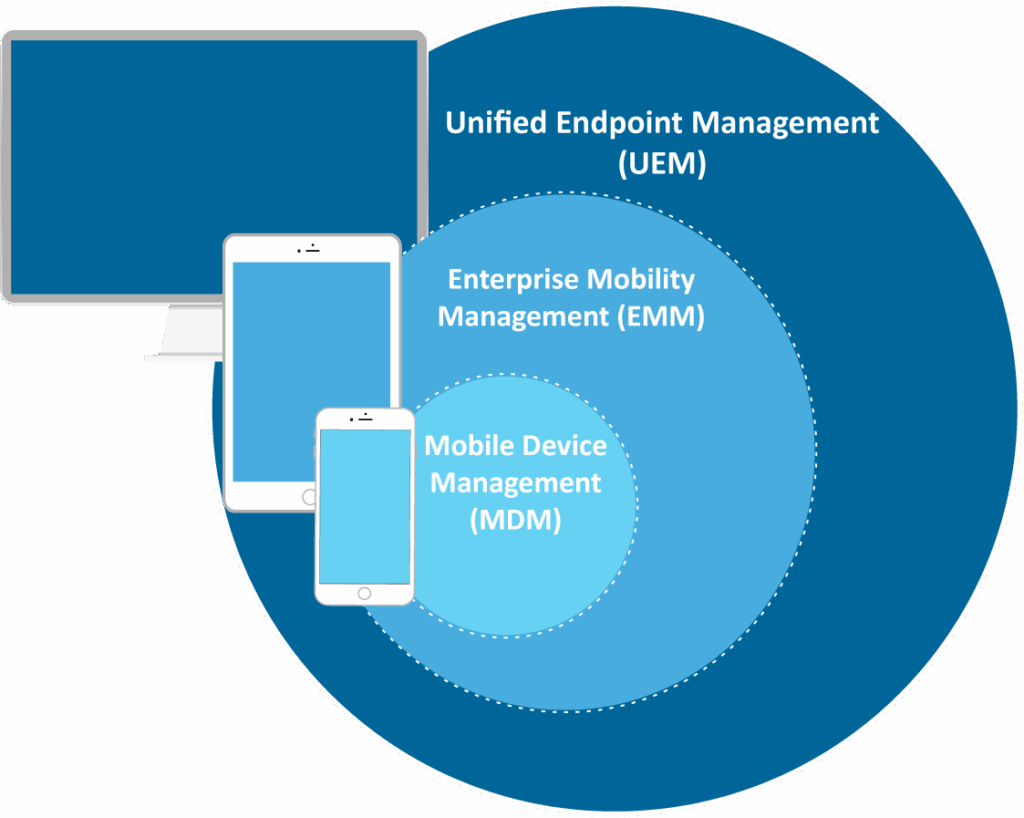
Depending on the company, EMM can therefore be part of an overarching unified endpoint management system. At the same time, Enterprise Mobility Management is made up of various components.
EMM as part of Unified Endpoint Management
UEM solutions include EMM solutions and additional client management tools for PCs, wearables, smartphones, tablets and other IoT devices. This makes it possible to manage users, devices, apps and data with a single solution. However, such solutions are very time-consuming for IT to manage.
The components of an EMM
One part of Enterprise Mobility Management is the Mobile Device Management, which companies use in most cases for the Securing company-owned mobile devices use. With an MDM solution, the IT department can, for example, unlock and lock mobile devices when an employee leaves and specify and enforce rules for the use of devices and apps.
In addition to an MDM, the following components are part of Enterprise Mobility Management:
Mobile application (or MAM for short) solutions are used to provide employees with mobile apps, usually via a user-defined app store. These can be your own apps, but also apps from third-party providers.
With Mobile Content Management (MCM), employees can access, edit and save important company content from mobile devices.
This component is responsible for secure and simple login procedures, for example to access company data. This includes certificates for users and devices, authentication, single sign-on processes and, increasingly, contextual information such as the location and time of a login